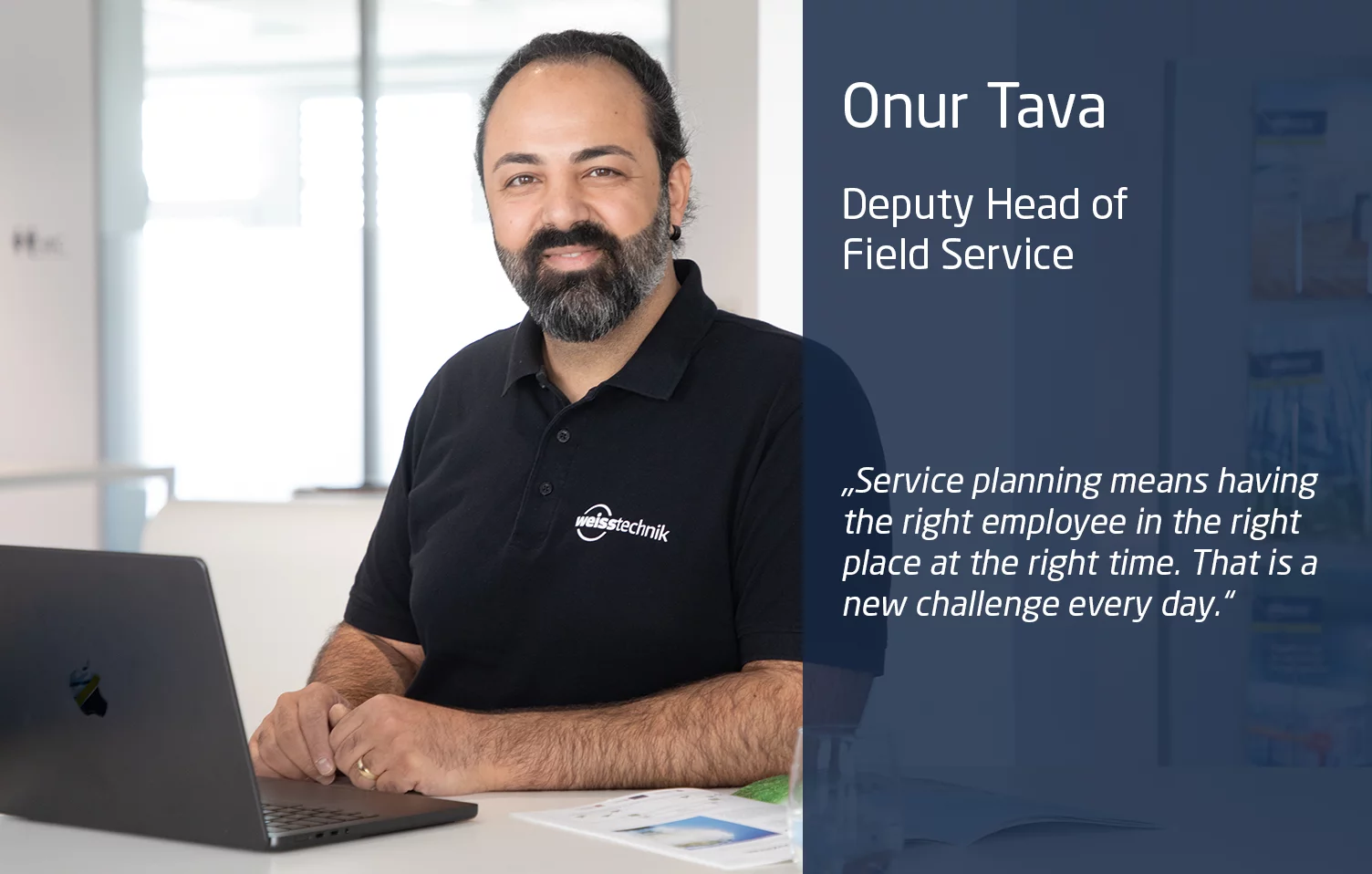
Mr Tava, do you enjoy your service work?
Absolutely. But you need nerves of steel. After all, it doesn’t matter if its a small pharmacy, a pharmaceutical manufacturer or a huge data center: when the climate technology gives up, it’s all hands on deck. The only thing that helps is keeping a cool head, even when the mood heats up.
What’s your core task in the Service department?
I’m at the steering wheel essentially: when the climate technology comes to a standstill, my 10-person team sets to work. It may look like a purely organizational task, but in reality it’s much more than that. It’s important to be able to precisely estimate the needs of the customer and the strengths of the team. This isn’t something you learn over night – rather, it’s a skill you acquire with every discussion, every experience and every time we’re called out. These days, I often know right away when that first call comes in which technician can best help the customer. Ultimately, it comes down to finding the right match and bringing the right people together at the right time to make sure the technology runs and the customer is happy.
How do you support your customers when the technology fails?
Sometimes it’s just a quick tip over the telephone, sometimes remotely via our Vindur cockpit and often with a technician directly on site. It’s a definite advantage here that our technicians are not only familiar with the defective component but also know the system as a whole. I coordinate these call-outs but it’s my service technicians that help the customers directly.
Is it just in emergencies that you organize assistance?
We can be contacted day and night, every day of the year. Luckily, though, most of our work involves plannable call-outs: commissioning, qualification, re-qualification or maintenance. When you keep a good eye on ongoing maintenance, special customer requirements, available technicians and appropriate time windows, emergencies can be avoided for the most part. And if they do happen, our emergency service is available 24/7.
Do you also carry out retrofit measures?
Yes, we do that too. This usually involves modernizing existing systems in terms of technology, optimizing them in terms of energy consumption or integrating new functions. That’s often quite exciting – some of our systems have been in continuous use since the 1970s and are still going.
What is your largest service project?
Twice a year we have a particularly demanding project: the simultaneous maintenance and re-qualification of 15 cleanrooms of a large pharmaceuticals manufacturer. During this short, highly intensive phase, the whole production line is shut down. Every minute counts. Our technicians give everything they’ve got to successfully re-qualify the cleanrooms within the tight time frame. An experienced and tightly coordinated team is essential in making this work.
How do you organize such a complex and time-critical project?
We prepare these call-outs down to the last detail. Our service technicians carry out various comprehensive cleanroom measurements such as a purity class measurement, recovery time measurement, filter integrity test and so on. More than 260 rooms with over 1,200 HEPA filters are inspected. At the same time, the complex climate and ventilation systems of the cleanrooms as well as the cleanrooms themselves are serviced, components calibrated and checked for compliance with all specifications. The GMP-compliant documentation of these processes comprises between 30 and 50 files every time and ensures that all steps are traceable, verifiable and auditable.
How do you ensure the success of a project like this?
It all comes down to planning and a perfectly coordinated team. Luckily, it has worked really well for around 20 years. Service technicians from all over Germany come together during the call-outs and work closely as a team over a period of several weeks. For many, this is a special experience, since they rarely get together with their colleagues for so long otherwise. Everybody in the team understands the urgency and knows that every action has to be perfect if the project is going to run according to plan.
What does the customer get out of carrying out a mammoth project like this?
Everything runs quickly, smoothly and coordinated – and our service technicians can jump in immediately if a problem crops up. Instead of having to call external service providers, the solution is often just one simple intervention away. This saves time and costs and keeps processes running, so that production can continue at full speed directly afterwards.
What does a project like that mean to Weiss Technik and the team?
Naturally, it’s something very special to participate in such a unique project. But it has another effect, too: in putting together the team, we can also deliberately promote a transfer of knowledge within the team. From experienced specialists to the younger ones and the other way around: everybody has something to contribute that can help the others. At the end of the day, everybody benefits from this – including the customers.
Speaking of young specialists: is your Service department fit for the future?
Definitely. We’ve implemented a lot of digitalization in the last few years – for example, the entire planning and the connection to the field service. On top of this, we have many other project that keep our Service department cutting-edge and fit for the future.
Do you use any other digital or remote solutions in the Service department?
Yes, our innovation Vindur cockpit, for example. Quick action is particularly decisive when it comes to disruptions in critical areas. The intelligent networking of our systems means that we can identify many problems at an early stage and often remotely. Not only does this save time, it also makes our servicing much more efficient. And when a call-out on site is necessary, our team is best prepared and receives all relevant information digitally and in advance.
What innovative service tools will you be introducing next?
We are currently nearing the finishing line with our “MyWeiss” customer portal. In the future, customers will be able to log in centrally there for an overview of all of the systems and devices supplied by us – from technical specifications and maintenance information to the connection to our ticket system. This will make our services even more transparent, faster and more efficient. After roll out at the end of the year, we will of course continue to check which functions we could still integrate. AI is currently opening up a lot of exciting possibilities.
Many thanks, Onur Tava for the chat and enjoy your lunch.
Info bite Onur Tava
Onur Tava is 38 years old and has come up through the ranks at Weiss Technik. After completing his apprenticeship as an industrial clerk, he joined the service department at Weiss Klimatechnik in 2014. As a team leader and deputy head of the field service department, he now holds a dual role. When he’s not looking after his customers, he likes to relax with a walk or a good film. However, his favourite stars are always his wife and his two young children.