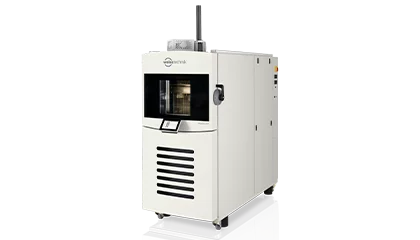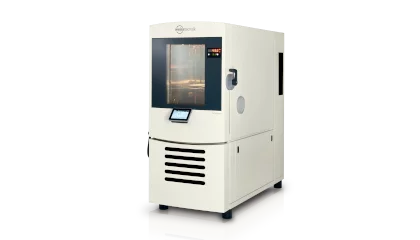
Rectangular access port 160 x 50 mm to the left
The rectangular access port (160 x 50 mm) is installed in the left-hand wall. It allows the insertion of larger or several plugs and cables that do not fit through the standard access port.
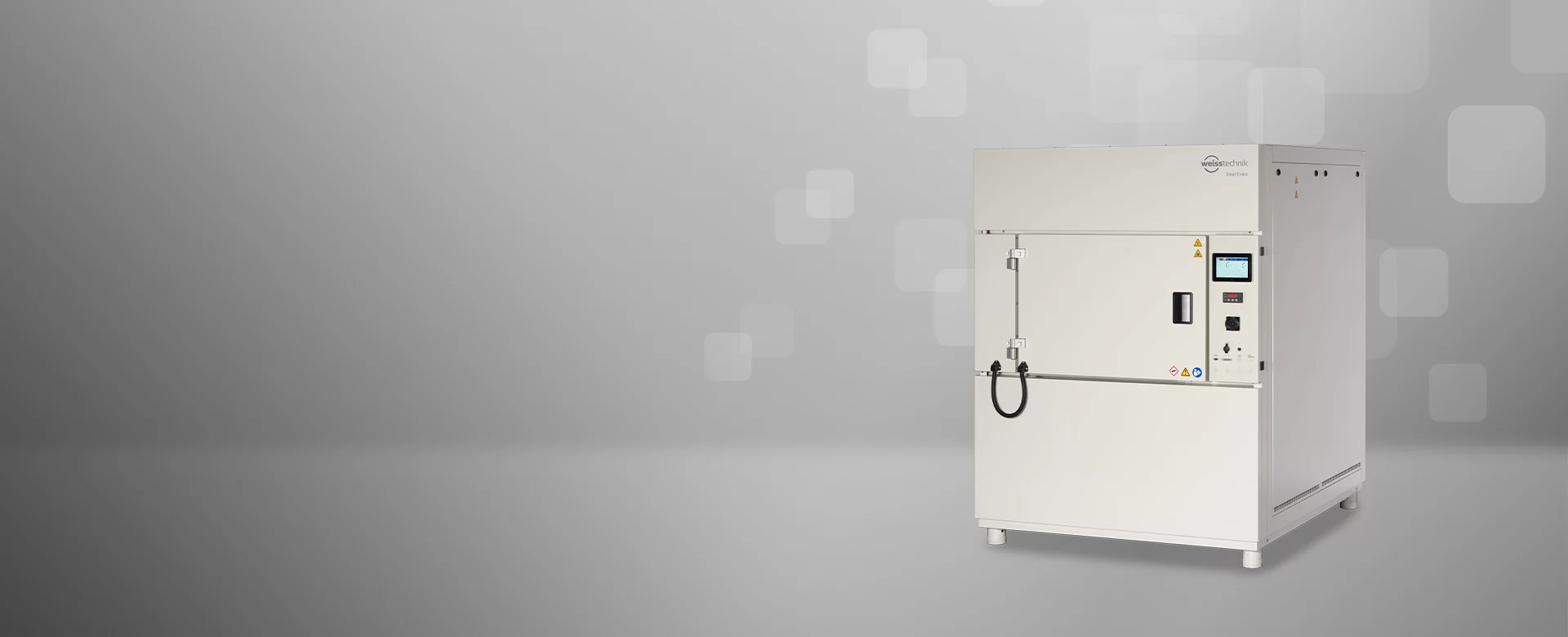
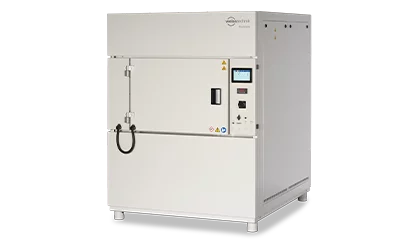
ShockEvent D damper-type shock test chambers with fixed test space are ideal for vibration-sensitive or active test objects such as sensors and other electronic components. During the thermal cycling test, temperature-controlled hot or cold air flows into the test chamber to the test specimen. This means that the test specimen remains stationary and does not have to be moved between several temperature chambers, as is the case with horizontal and vertical shock test chambers.
The fixed test chamber allows for optimal stress conditions without having to move the test specimen. Cables and test setups can be easily fed through the side wall and remain stationary, just like the test specimen.
The thermal shock test method, which uses three temperature zones (cold, hot, ambient) within a single chamber, offers greater flexibility in testing procedures than conventional thermal shock chambers.
In energy-saving mode, the cold and hot chambers are temporarily turned off during programs with long dwell times. This significantly reduces energy consumption.
Multi-level safety mechanisms, such as automatic shutdown of the test specimen, over-temperature protection, and lockable doors, protect both operators and the test specimen.
The standard 50 mm feed-through and the large test chamber door ensure easy installation of the test specimen as well as convenient loading and unloading.


The temperature can be preconditioned between 55°C and 225°C in the hot chamber above the test space. The air enters the test space from there via a flap mechanism.

The temperature can be preconditioned between -80°C and 0 °C in the cold chamber underneath the test space. The air enters the test space from there via a flap mechanism.

Operation/programming and monitoring unit with 18 cm (7"). With this, all settings can be made and test programs can be conveniently programmed.

Independently adjustable temperature limiter tmin/tmax, separate sensor installed in the test chamber. Dehumidifier to prevent condensation formation on the sample. Software temperature limiter tmin/tmax, individually adjustable fixed value. Potential-free contact specifically for heat-emitting test specimen, connected to socket max. load 24V 0,5A.<br />

The master switch allows the user to turn the entire chamber on and off centrally with just one movement. This helps to save energy and increases safety when the device is not in use.

USB port for data recording (csv) and four digital inputs and outputs as standard. Control and data recording via the network connection with S!MPATI® software. Control via external programs using the SimServ protocol is also possible.

The condensate drains away via the condensate drain at the rear.

Grid shelves can be placed on seven levels in the test space, which is made of corrosion-resistant stainless steel 1.4301. Maximum load: 150 kg.

The large test space door allows convenient loading and unloading of the test space and is opened and closed with the integrated handle.

For easy installation, the damper-type shock test chambers are equipped with a 50mm access port and a fitted silicone plug as standard.

A mains connection, cooling water connections, a compressed air connection, a condensate drain and an Ethernet interface can be found on the rear of the chamber.
In contrast to other shock test chambers, the ShockEvent D damper-type shock test chamber works with a fixed test space. Temperature-controlled hot and cold air is pre-tempered in chambers above and below the test chamber. The damper-style shock test chamber allows this air to flow into the test space via flaps. This makes it significantly different from horizontal and vertical shock test chambers, in which the test specimen moves between two or three temperature ranges in a test basket.
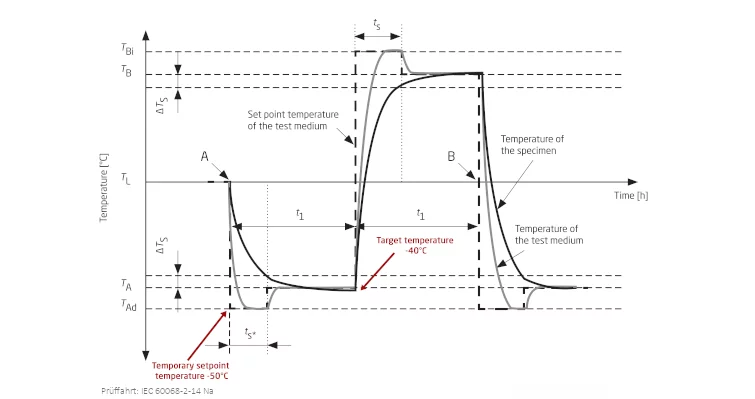
The ShockEvent D is designed for performing common thermal shock test standards.
|
Shock operation
|
|
EIAJ ED-2531B Na
|
|
IEC 60068-2-14 Na
|
|
JASO D 014-4
|
|
MIL-STD 202H, Meth. 107
|
|
MIL-STD 883L -2, Meth. 1010.9 (A, B)
|
 | ||
|---|---|---|
| Testspace volume (l) | 210 | |
| Test Space Dimensions (H x W x D) [mm] | 500 x 700 x 600 | |
| External Dimensions (HxWxD) [mm] | 1970 x 1485 x 1765 | |
| Temperature Range Test Room | -65 ... 200 | |
| Recovery time Cycling Test MIL-STD-202G (min) | 5 | |
| Recovery time Cycling Test MIL-STD-883-1 Method1010.9 (min) | 15 | |
| Power Rating (kW) | 31.9 | |
| Sound Pressure Level (dB(A)) | 63 | |
| Download spec sheet |