
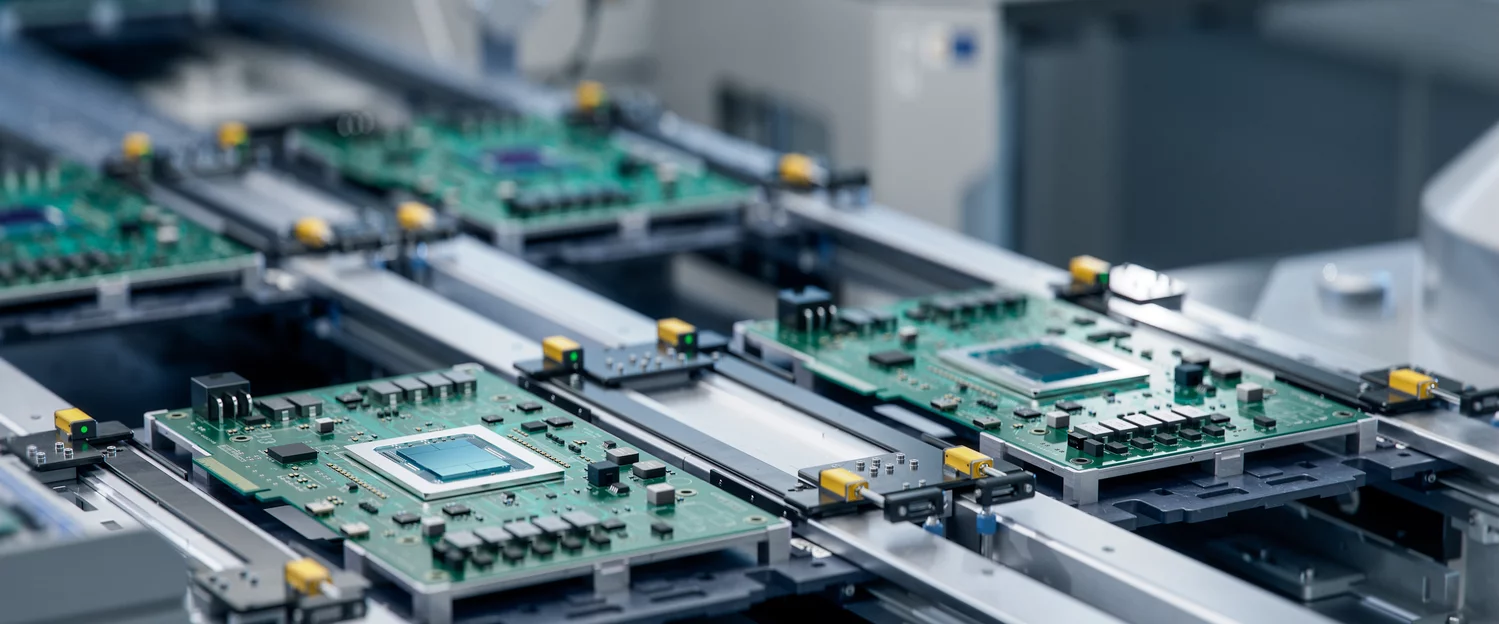
Electronic components such as AI chips, PCBs and SoCs are tested intensively in environmental, aging and stress tests. An enormous amount of waste heat has to be discharged during the testing of high-performance chips. In end-of-line tests, the high cycle rates of the industrial production are also a challenge. As a specialist for environmental simulation, Weiss Technik offers a large portfolio of individually adaptable test chambers for different standards and test scenarios.
Conduct tests with high thermal loads safely
Be it a dynamic start-up or an established big player: every developer of high-performance electronic components needs powerful testing technology. Environmental stress screenings (ESS) for chips for AI data centers, drones, and other electronic systems generate high heat loads during testing. Suitably equipped test chambers, such as those offered by Weiss Technik, are required to dissipate this heat safely. So-called blast chillers, also known as stress screeners, achieve change speeds of between 10 and 30 K/min. The higher the change speed, the greater the heat compensation, meaning that more chips can be tested in parallel.
Which standards and test specifications must be met?
Stress, function and long-term tests are performed in the high-performance test chambers to examine the test specimens for function and possible vulnerabilities such as material degradation or insulation failure. Differing standards or customer-specific specifications must be met, depending on the test specimen and the test objective. The international standards series IEC 60068-2-xx, the standard for semi-conductor devices JEDEC JESD22-A101 and the technical standard of the US Department of Defense MIL-STD-810H are often applied. Manufacturer-specific specifications also apply.
Integrated safety and protection against condensation
Demanding electronic testing is technically challenging. For this reason, ClimeEvent test chambers are designed with a comprehensive safety concept. For example, the test specimen can be actively switched off, and hardware and software temperature limiters can be set independently of each other. To protect staff, testing technology and test specimens even in the event of malfunctions and incorrect operation, the test chambers are optionally equipped with electrical and mechanical locks.
In long-term tests of 1000 hours or more, it is important to precisely maintain constant conditions and avoid planned downtime. When long-term tests are carried out at high temperatures and a high dew point, condensation can form on the ceiling. Dripping on to the specimen is not permissible under the norms, affects the test result and can damage the test specimen. For this reason, all temperature and climate chambers from Weiss Technik have a double, air-flushed ceiling in the test chamber to reliably prevent dripping.
Extensive standard equipment and customized additions
Numerous options are available alongside the standard equipment to adapt the test chambers to specific requirements. If the test specimen is sensitive to electrostatic charge or if the test chamber is to be located in an EPA (electrostatic protected area), appropriate precautions can be integrated. For sensitive electronic products, test chambers can be implemented that are silicon-reduced or silicon-free. And if testing in a low-oxygen atmosphere is required, the test chambers can be equipped for the performance of nitrogen testing.
Industry-proof end-of-line tests maintain high production cycles
To ensure maximum product quality, many chips and electronic test specimens undergo a 100% functional test at the end of production. To ensure that the automated or semi-automated production flow is not disrupted by this, the test item must be loaded and unloaded as quickly as possible. With customized, detailed solutions, Weiss Technik ensures fast and efficient contacting and insertion of the test specimen. The test chambers can also be easily integrated into the production environment thanks to standard and SECS/GEM interfaces.
Are test chambers efficient and sustainable under maximum load?
In tests in accordance with classic norms from the electrical industry, precision and reproducibility have top priority. At the same time, it is important to reduce the TCO (total cost of ownership), especially in energy-intensive tests with rapid temperature changes. The targeted energy savings reduce testing costs and help to achieve sustainability goals. Weiss Technik equips high-performance chambers in the stress screener segment with the “Greenmode” energy-saving mode as standard. This minimizes energy consumption by running only those components that are currently needed. This reduces consumption costs and at the same time reduces component wear. Moreover, test chambers with a cooling capacity of up to -50 °C use CO2 with GWP 1 as a refrigerant. This means that they not only meet regulatory requirements, but also enable more efficient operation and a significant reduction in the CO2 footprint.
Suitable standard solutions for demanding electronic tests
Electronics testing is a matter of trust. As one of the most prominent suppliers of high-performance test cabinets, Weiss Technik stands for a large selection of standard cabinets that can be adapted to meet requirements. They have test room volumes of between 270 and 1,300 liters and achieve temperatures of between -70 and + 180 °C and temperature change rates of between 10 and 25, optionally even up to 30 K/min. Thanks to the 1.4404 stainless steel test chamber and a robust design, they are ideally suited for use in the electronics industry and test laboratories. In combination with many years of experience and a high level of consulting expertise, Weiss Technik thus offers safety, cost-effectiveness and sustainability in the testing of high-performance electronic components.