
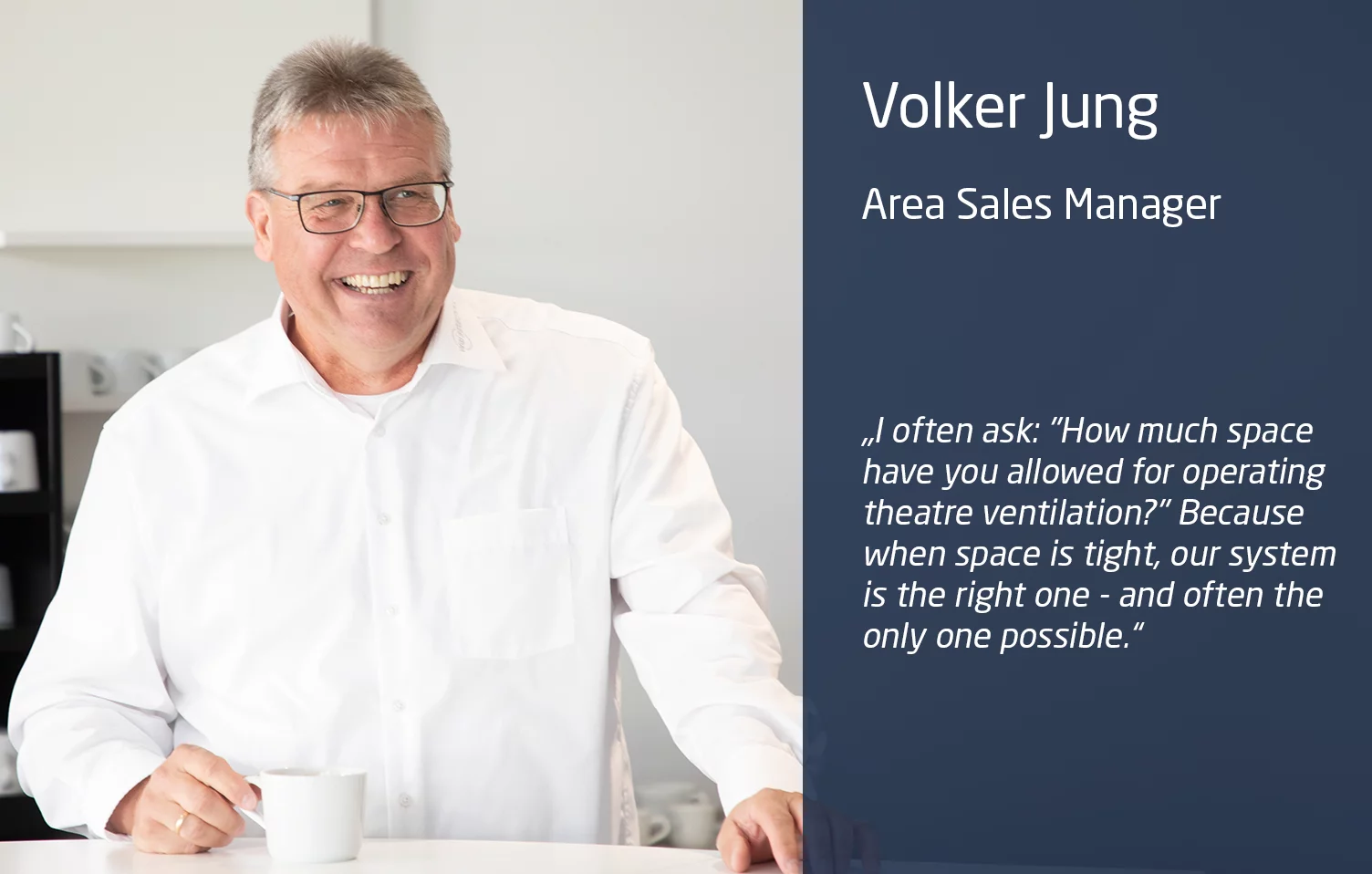
“I often ask: How much space have you allocated for the OR ventilation system?” Because when space is tight, our system is the right choice—and often the only possible one.
Volker Jung on hygienic climate control for modern operating centers: space-saving, hygienic, and economically efficient.
Friendly, focused, and engaged: Volker Jung arrives in great spirits for the Technology Lunch and opts for the daily special, gnocchi with chanterelles. To drink, he orders a cola and later an espresso. In conversation, he talks about current and completed projects that balance hygienic requirements, structural possibilities, and economic considerations.
Mr. Jung, what is the focus of hygienic climate control for operating rooms?
First and foremost, it’s about understanding the hygiene requirements, the customer’s ideas and expectations, and the structural conditions. That works best when we start the conversation early and are involved right from the planning stage. By that point, decisions that may negatively affect the climate control system have often already been made.
For which medical room classes do you offer solutions?
We can cover everything from Room Class 2 to 1B and even 1A. In my view, it is still unjustly debated whether Class 1A ORs with laminar flow are necessary. As early as 2013, a Hybeta study showed that the microbial contamination of surgical instruments in Class 1B ORs is about 150 times higher than in Class 1A ORs. Everyone can draw their own conclusions about what that means. Personally, I would rather be operated on where the microbial load is lowest—ideally under a Weiss ceiling. However, the user must ultimately define the room class in coordination with hygiene specialists and the local health authority.
What are the biggest challenges in OR planning?
Developing a suitable hygienic climate solution for operating rooms in accordance with the Infection Protection Act and the requirements of DIN 1946-4, and coordinating with the relevant health authorities, is always an exciting task. The biggest challenge usually arises from the structural conditions.
In what way are the structural conditions a problem?
It usually comes down to the space we have—or don’t have. If the architect of a newly built hospital has planned for a large mechanical room, everything is fine. But things often turn out differently: because every square meter of building space is costly, planning is done to save as much space as possible. And when it comes to implementing the climate control technology for the ORs, space becomes an issue because there’s often not enough of it.
How do you solve the space problem in ORs?
With our extremely space-saving Vindur® Room In and Vindur Compact air-conditioning units. If an OR is smaller than 30 m² and there is no separate technical area, I install the Room In unit directly in the OR. If the OR is larger than 30 m², a small 6–7 m² mechanical room is required. The units handle the complete air treatment—heating, cooling, humidifying, and dehumidifying. We then install terminal filters in the duct system to meet the required room class. As a result, our solutions are ideal for the many newly emerging medical centers and outpatient clinics approved under Section 30 of the German Industrial Code.
Are outpatient clinics and practices with operating rooms a new trend?
Not new, but definitely a trend. We currently have many projects in this area. Take cataract surgeries, for example. These procedures take around 10 minutes, and there’s usually no reason for patients to stay in the clinic any longer. Then there are more and more cosmetic clinics performing outpatient procedures. And new medical centers are emerging that perform outpatient procedures such as simple knee, hip, and shoulder surgeries. This shift toward outpatient care makes economic sense. Clinics can perform profitable operations without maintaining extensive facilities or non-medical staff.
So that means you also equip these clinics and centers?
Yes, alongside traditional hospital ORs, this is one of our key focus areas. Yes. We offer the complete package—from planning and execution to final approval. That’s important because such projects usually require extensive coordination. For example, with the approving authorities such as local health departments. We provide full consultation and support to our customers, including assistance during discussions with the authorities. This can simplify processes and, above all, speed them up. Once a project is completed, we also provide after-sales service in most cases.
What’s special about outpatient medical centers?
Many projects involve renovations or expansions of existing buildings and spaces. For example, if an operating room is to be integrated into an established medical practice in a prime downtown location, completely different structural requirements must be met than when building a hospital on a greenfield site. The focus is often on minimizing the space required and developing creative solutions for air distribution and treatment.
Do you also offer solutions for other medically used rooms?
Yes. We provide hygienic climate solutions for other areas where special protection of the occupants is necessary or required. These include intensive care units, patient rooms, and recovery rooms classified as Class 2 rooms. And of course, CT suites and sterilization rooms, which, along with air hygiene, have specific requirements for heat removal.
How do you ensure hygiene requirements in Class 2 rooms?
Usually with a Vindur® Top secondary air-cooling unit. That’s one of our own developments and a robust, high-quality unit. The great thing is that it can be adapted to the specific air hygiene requirements as needed. In its standard configuration, it features two-stage filtration, and the internal panels are coated with antimicrobial silver ions. Additional options include UVC lamps, H14 HEPA filters, and, as a highlight, our thermal disinfection feature.
What does thermal disinfection mean in secondary air cooling units?
In many medical practices, air-conditioning units are switched off for periods of time. Condensate then forms inside the unit, thereby creating a breeding ground for microorganisms. When the system is switched back on, these can be distributed throughout the entire room. That’s why, during thermal disinfection, we heat the condensate tray and heat exchanger to above 70°C for a defined period to ensure that all microorganisms are safely eliminated. This allows the unit to be restarted in a hygienically sound state—even after a long period of downtime.
So does that mean you have a suitable solution for every type of hygienic climate control?
Not for every case, but for most. We have extensive experience and the right equipment for new hospital buildings, hybrid solutions to upgrade Class 2 rooms to Class 1B as well as for examination rooms and patient rooms.
Thank you for the conversation, Mr. Jung—and enjoy your meal.
Information snippet Volker Jung
Volker Jung, a graduate engineer in energy and heating technology, has been working in sales at Weiss Klimatechnik for more than 33 years. Originally, the family man wanted to work in research and development, but he has never regretted his career path. No wonder: as a successful former track and field athlete and table tennis player, he knows how to gain a competitive edge with technique, endurance and speed – making him perfectly suited for sales.