
Many data centres are facing major challenges: climate neutrality by 2030, more cooling capacity on the same footprint, and increased energy efficiency. Weiss Klimatechnik offers alternative cooling solutions ideally suited for retrofitting brownfield data centres.
Operators of older data centres are under increasing pressure to modernise. The use of AI applications and new server generations is significantly increasing rack power density. The result is a higher heat load per square metre, and existing cooling systems are often unable to handle this. In order to dissipate the rapidly rising heat load safely, efficiently and cost-effectively while meeting regulatory efficiency requirements, extensive retrofit measures are required in many cases. To meet this need, Weiss Klimatechnik offers Vindur CoolW@ll, a proven and highly efficient cool wall system that is particularly effective in brownfield projects.
Cooling solutions for data centres for over 40 years
As a German plant manufacturer and system partner, Weiss Klimatechnik is a pioneer and an experienced specialist in safe, highly efficient cooling solutions in data centres. By separating the cooling unit from the fan, which was installed separately in the raised floor, Weiss Klimatechnik has had a lasting impact on the way heat is removed in data centres. Today, Weiss Klimatechnik offers the most powerful room-based air-cooling system on the market, with an output of 50 kW. However, requirements are changing: “Anyone aiming to achieve a greater cooling capacity with a lower energy consumption on the same footprint must modernise their system,” explains Christoph Löhner, International Sales Engineer at Weiss Klimatechnik. “Not all data centres can switch to direct liquid cooling just yet. That’s why we are offering CoolW@ll, an intelligent, highly efficient, and future-proof bridging technology,” says Löhner.
Modernisation pressure on data centres
Digitalisation, cloud computing and AI require increasingly powerful IT infrastructures. Operators must also lower energy costs and improve efficiency. This is driven in part by the EU Energy Efficiency Directive (EED) and the German Energy Efficiency Act (EnEfG) as well as the mandate to achieve climate neutrality by 2030 and make greater use of waste heat. Many older data centres have a power usage effectiveness (PUE) value between 1.8 and 2. This is 30–50% above the level of modern facilities. Because around 60% of the total costs over a ten-year period can be attributed to operations, improving efficiency is a crucial driver of overall cost effectiveness.
Direct liquid cooling is a future technology with limitations
In new data centres, direct liquid cooling is considered the highly efficient cooling concept of the future. In this technology, a cooling liquid cools the CPUs directly, and the cooling is applied right at the heat source. For refurbishments and brownfield projects, however, the conversion is still complex and cost-intensive. Pipes and lines must be installed throughout the existing building and must reach every rack and every server. In addition, direct liquid cooling does not cover the entire heat load: around 30% still comes from hard drives and transistors, which require additional cooling, for example via fan walls. Another source of uncertainty is the current surge in technological development. “Anyone making a major investment in liquid cooling today cannot be sure that the solution will still be adequate in three or five years,” says Löhner.
CoolW@ll as a proven bridging technology
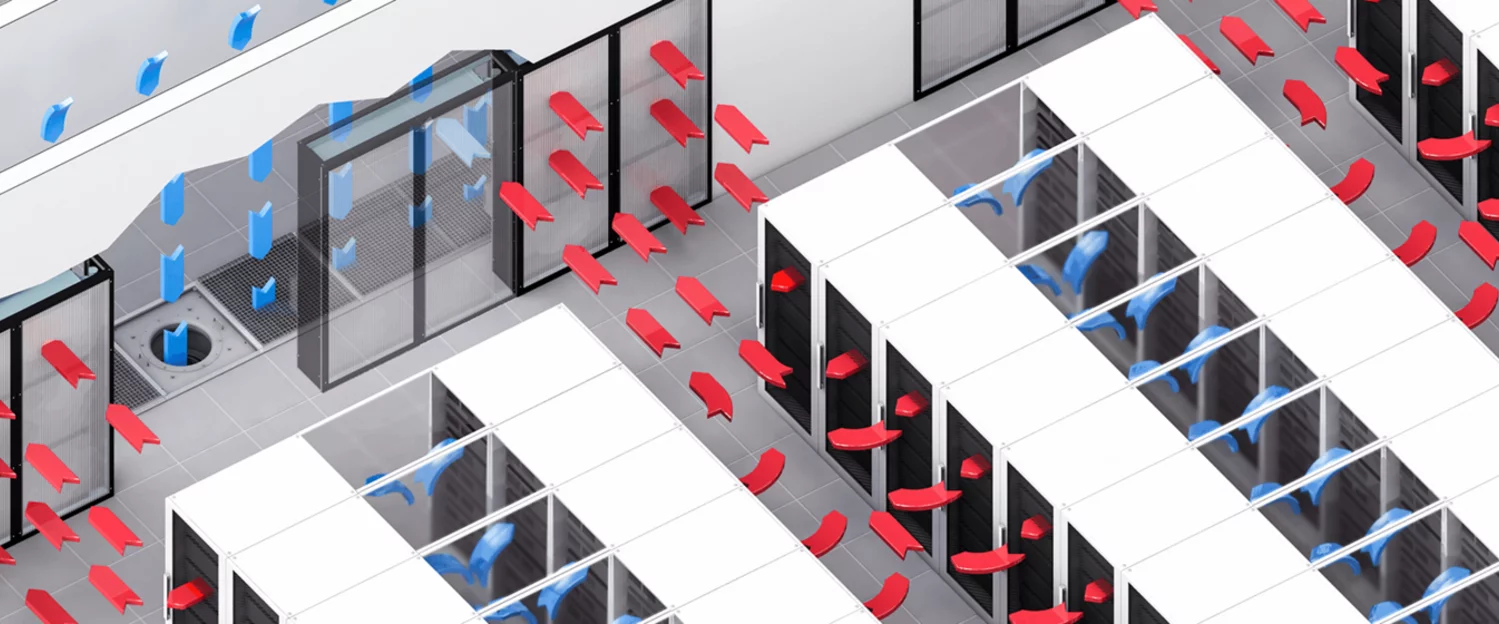
As a highly efficient and economical bridging technology for large and very large heat loads, Weiss Klimatechnik uses the proven CoolW@ll technology in numerous retrofit projects. The patented system reduces energy costs by up to 25% compared with conventional cooling solutions and is designed with future server generations in mind. Unlike traditional cooling systems, CoolW@ll is not housed in a cabinet; instead, it uses a significantly enlarged cooling surface. Water-fed heat exchanger modules are integrated into the partition wall between the supply infrastructure and the IT room. The fans are installed in the raised floor or the return air ceiling, thereby creating more space for the heat exchangers. With the larger heat exchanger surfaces and optimised airflow, even very large heat loads can be dissipated with exceptional efficiency.
CoolW@ll optimised for waste heat recovery
CoolW@ll cooling systems can be combined extremely well with waste heat recovery systems and therefore meet the EED requirements. The large heat-exchanger surfaces allow a higher water supply temperature of around 20°C and a return temperature of about 28°C. The temperature difference of nearly 10°C compared with conventional systems greatly improves the efficiency of waste heat recovery. The higher temperature level extends the application range of indirect free cooling, allowing it to be used even at higher outdoor temperatures. Overall, this reduces the reliance on costly mechanical compressor cooling.
Low installation and transport costs
In addition to acquisition and energy costs, transport and installation costs also play a decisive role, especially in retrofit projects. In the room-based CoolW@ll system, all components are installed separately, thereby simplifying transport and installation and reducing costs compared with large, pre-assembled systems. Existing cooling technology generally remains in place; only heat exchangers and fans need to be replaced. Maintenance and servicing are also extremely efficient because work can easily be carried out from the rear of the CoolW@ll units. Unlike direct liquid cooling, technicians do not need to enter the server rooms. If a component fails, it can be replaced or repaired individually without removing the entire unit.
CoolW@ll as a future-proof cooling solution
The CoolW@ll system provides an efficient and secure cooling solution for many retrofit and brownfield applications in data centres. It helps reduce energy consumption and improve PUE values. CoolW@ll also supports more efficient use of available space, thereby allowing additional servers to be housed per square metre. Installation is quick and straightforward and requires only minimal effort. CoolW@ll is also ideal for hybrid cooling scenarios and for supplementing a direct liquid cooling solution.