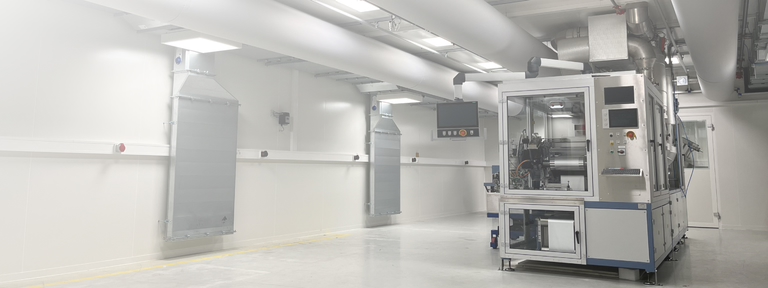
Dry Rooms for Research, Development, and Scientific Institutes
Precise humidity control for battery research—from material development to the pilot line.
Dryness is non-negotiable in battery research
Lithium reacts with atmospheric humidity—even traces of water impair the cell chemistry, capacity, and safety of batteries. For research institutions and development laboratories, different requirements apply here than in series production: Flexibility, rapid parameter adjustment, and variable dew point control are decisive.
Lithium and lithium-containing electrolyte compounds react strongly with water molecules in the air. The result is electrochemical side reactions that reduce capacity, shorten service life, and in extreme cases release flammable hydrogen gas. For processing electrode materials, electrolytes, and lithium metal foils, controlled low-humidity environments are absolutely essential.
Research is not an assembly line—different requirements than in series production
In series production, a dry room is optimized around a defined process: constant dew point, fixed room dimensions, high throughput figures. Once set, the system runs stably—changes are rare and costly.
Research and development laboratories face a fundamentally different scenario:
- Process parameters change frequently, sometimes daily.
- New materials and cell chemistries require different humidity conditions.
- The number of people in the room varies—from individual experiments to team operation.
- Systems must be able to be reconfigured, supplemented, or replaced without permanently rebuilding the room.
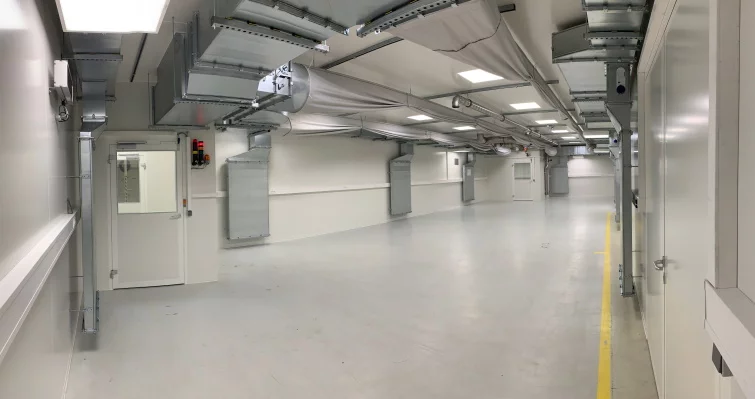
Even during planning, attention must be paid to making the operating parameters flexible.
| Feature | Series Production | Research & Development |
|---|---|---|
| Dew point | Fixed setting (e.g., –40 °C or –60 °C) | Variable and adjustable (–30 °C to –70 °C+) |
| Room size | Large to very large (100–10,000 m²) | Small to medium-sized (10–200 m²) |
| Process stability | High continuity required | Frequent process changes anticipated |
| Personnel load | High automation, few personnel | Changing number of people, manual operation |
| System configuration | Permanently installed | Modular, reconfigurable |
| Energy optimization | Scaled for continuous operation | Operation frequently intermittent |
| Standards requirements | Strict (series processes, audits) | More flexible, research-oriented |
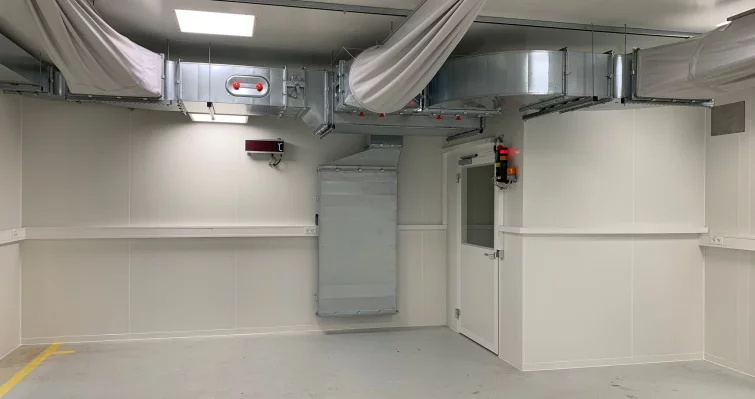
Changing operating parameters—without interrupting operation
In series production, the stability of the environmental parameters is a quality feature. In research, the targeted variation of parameters is the actual tool. Experiments require reproducible yet changeable conditions.
What straightforward parameter adjustment means in practice:
- Dew point setpoint adjustable via the control system: No modification, no recalibration of the overall system—the dehumidification unit adjusts to the desired target value.
- Switching temperature ranges: Relevant for material-specific experiments; heating and cooling concepts must be integrated.
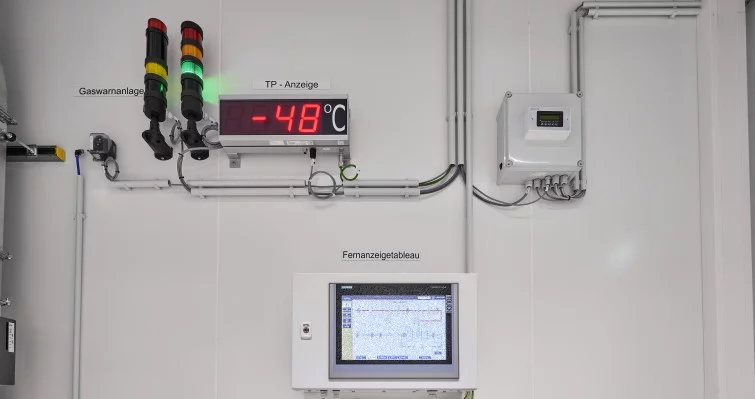
- Documentation and logging: For scientific evaluation, all parameters must be capable of being recorded without gaps and with precise time stamps.
- Quick start after modification: Following equipment changes in the room, the system should be able to return to the setpoint quickly—long ramp-up times cost experiment time.
Flexibility as a Design Principle
A research dry room must grow with the requirements of the projects. What is a material study with dew points below –40 °C today may tomorrow be a pilot trial at –65 °C with new plant technology.
In concrete terms, flexibility in dry rooms for science and R&D means:
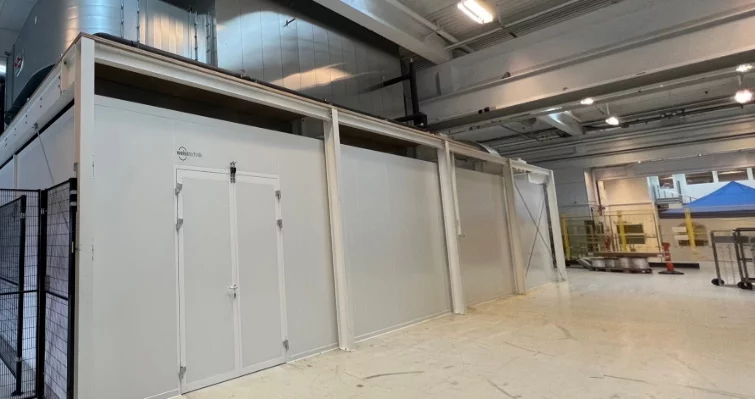
- Modular room structure: Partition walls, airlocks, and supply units should be reconfigurable without having to alter the entire building envelope. Prefabricated insulating panels enable rapid reconfiguration. Room-in-room systems allow modifications.
- Scalable dehumidification capacity: Desiccant dryers can be dimensioned in stages. In small laboratories, compact units are often sufficient—with defined interfaces for expansions.
- Interface openness for process equipment: Air outlets, cable entries, media feed-throughs, and power supplies must be able to be adapted to changing equipment configurations. Textile ducts are highly adaptable in this application.
- Compatibility with mini-environments: Particularly moisture-sensitive process steps can be encapsulated within the dry room in near gas-tight environments (so-called mini-environments) that provide dew points below –70 °C locally and energy-efficiently.
Humans as the largest moisture load in the dry room
In series production, human moisture input is minimized through extensive automation. In research environments, it is different: Scientists work manually, conduct experiments, oversee setups, and in doing so introduce large amounts of moisture into the room. In the dry room, a person releases around 120 g of water vapor per hour —through respiration, skin evaporation, and clothing.
This has considerable consequences:
- Each additional person in the room increases the required dehumidification output significantly.
- At very low dew points (below –60 °C), the required airflow rate can double due to a single additional person.
- Critical local moisture peaks arise where people work close to sensitive materials or open cells.
Defining the target dew point and process range
Personnel concept
Airlock concept
Sensors and monitoring
Infrastructure for process equipment
Safety planning