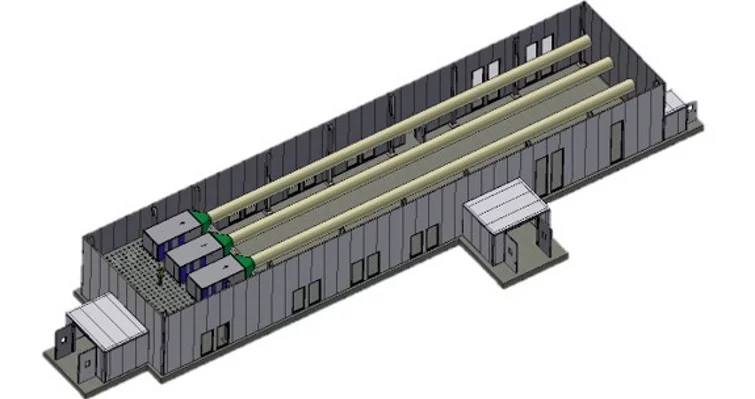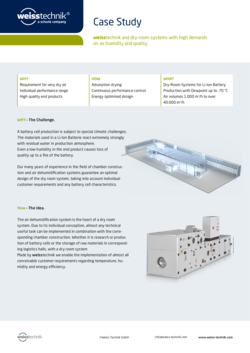
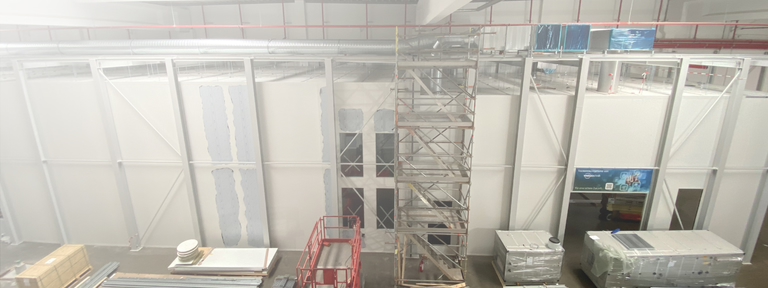
Dry room installation under construction with ventilation ducts and scaffolding in an industrial hall

Dry Rooms for Pilot Lines in Battery Production

Process flexibility and humidity control – where research meets production.

Contact request
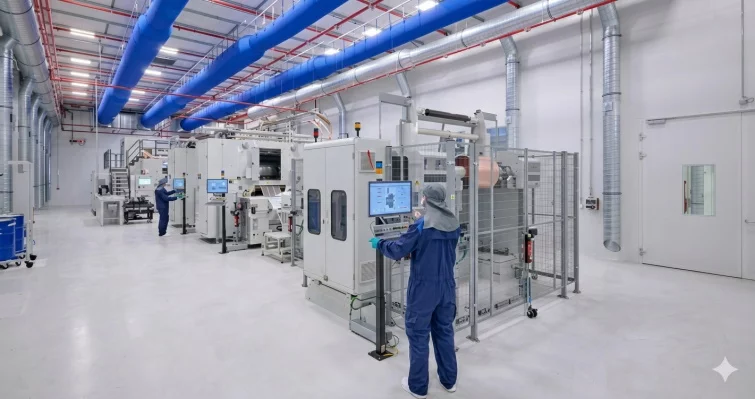
 Dry room for battery manufacturing with automated equipment and operators at control stations

Specific requirements for dry rooms at the scale between research and series production

Pilot lines in battery manufacturing are neither a research lab nor a series-production factory. They are both at once – and that is precisely what places special demands on dry room technology. Varying process steps, changing personnel, and frequent parameter changes require systems that can adapt without compromising humidity control.

Manufacturing must take place in controlled dry rooms where the dew point is regulated—depending on the process—to values between –30 °C and –80 °C , corresponding to a relative humidity of below 1% down to below 0.001%.

The consequence: the energy expenditure for this is considerable: depending on system size and degree of drying, dehumidification systems in battery dry rooms account for up to 40% of a factory's total energy consumption.

Three scale levels – three different requirement profiles

A critical mistake when planning dry rooms for pilot lines is to directly transfer concepts from research labs or series production. Both approaches are unsuitable for pilot lines.

No standard dry room concept meets pilot line requirements out of the box. Pilot line dry rooms must be explicitly designed for variability. For certain process steps in the pilot line—particularly at dew points below -60 °C or with all-solid-state materials—the technical and economic feasibility of a full-room concept can reach its limits. Mini-Environments offer a valid alternative here: compact, enclosed work zones within an already-dried dry room create locally even lower humidity levels—with lower energy input than a full room of the same degree of drying.


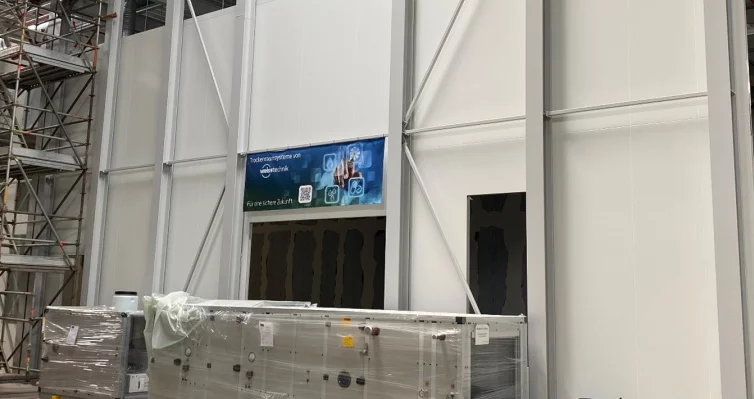
 Entrance to dry room with airlock and installed equipment in battery production environment

Criterion Research/Laboratory Pilot Line Series Production
Scaling Small batches, g to kg Medium-sized batches, variable formats Large volumes, standardized formats
Flexibility Maximum High—while maintaining reproducibility Low—optimized for a single process
Number of personnel 1–3 personnel 3–15+ personnel, rotating staff High degree of automation, fewer manual interventions
Parameter change Frequent, experimental Regular, documented Rare, only after validation
Dew Point Control Often via glove box, no full room needed Variable zoning required Fixed, defined dew point, optimized for throughput
Energy Focus Secondary Efficiency as a planning goal Primary optimization goal
Standardization Laboratory standards ISO 14644 applicable ISO 14644, product-specific quality standards


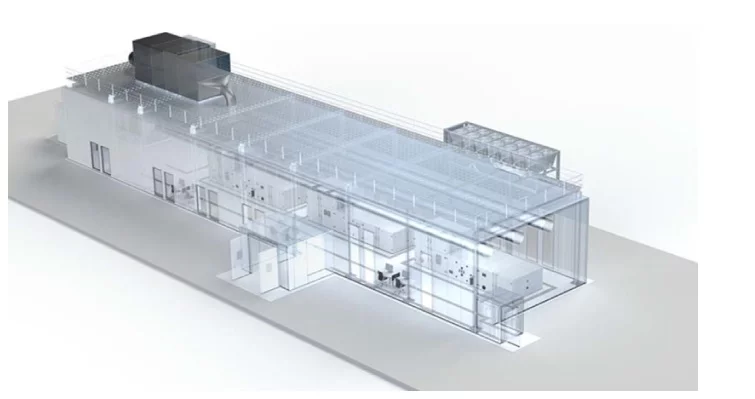
 3D model of a dry room with air duct system and integrated climate control for battery production

Moisture introduced by people: the underestimated variable

Humans are the largest and most difficult-to-control moisture source in any dry room. In series production, this problem is addressed through extensive automation. In research, the number of personnel remains low.

The pilot line is in neither of these favorable positions: it requires active personnel – for operating, retooling, adjusting, measuring, and documenting.

Humans continuously release moisture through breathing, perspiration, and vapor diffusion through clothing. In a dry room with a dew point of –40 °C, this input corresponds to a load case that is technically difficult to compensate for. The dehumidification system must continuously compensate for the moisture introduced by personnel present. Additional FFUs, internal air ducts, and internal steel structures support this.

Variable Dew Point Control: Adaptation as a System Feature

Not every process step in lithium-ion cell production requires the same degree of dryness. Requirements typically vary as follows:

Process Step Typical Dew Point Range
Electrode preparation, general –30 °C to –40 °C
Cell assembly (winding, stacking) –40 °C to –50 °C
Electrolyte filling –50 °C to –60 °C
Nickel-rich NMC, all-solid-state –60 °C to –80 °C


A rigid dry room system designed for the most critical step operates all less critical zones permanently at an unnecessarily low dew point – thereby consuming significantly more energy than necessary.

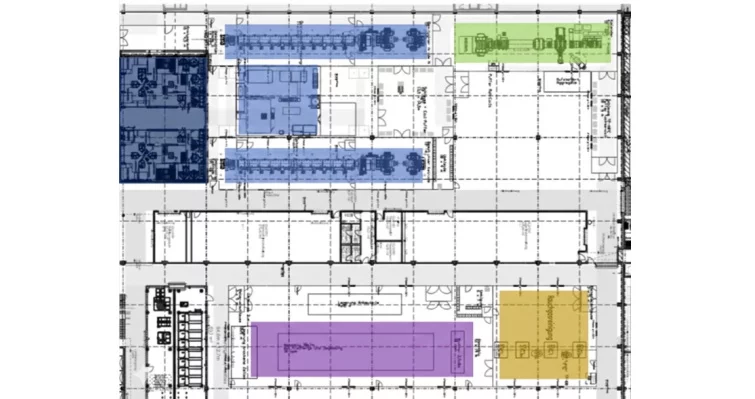
 Layout of a dry room pilot line for battery production with defined process and equipment zones

Parameter Changes in the Pilot Line: A Technical Requirement, Not a Special Case

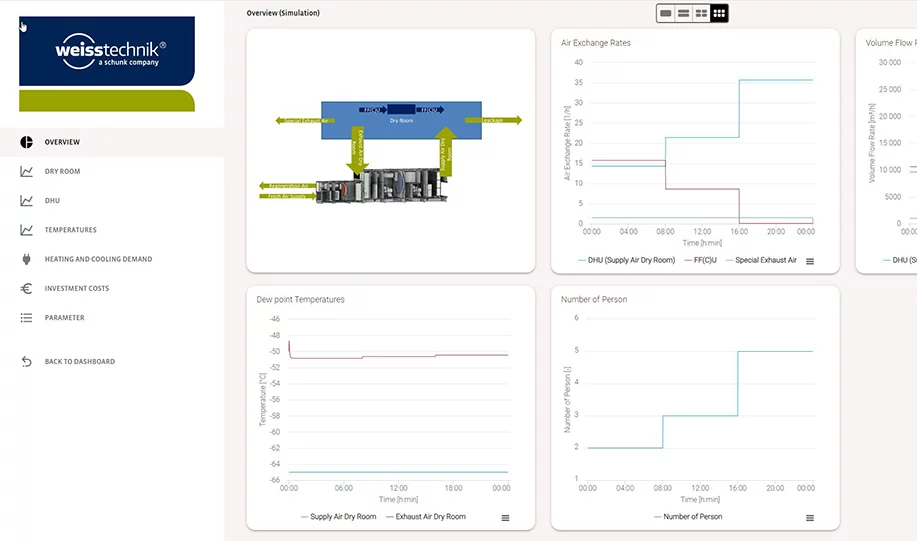
In series production, a change to the dew point setpoint is an event that goes through approval processes. In the pilot line, it is part of everyday work: When a new cell chemistry is tested, when electrolyte materials change, or when process optimizations must be documented, the dry room control system must be flexible and adaptable without extensive modification work.

Requirements for a flexible control system for pilot lines:

  • Digital setpoint changes without any hardware intervention
  • Recording of all state changes (change history, batch log)
  • The ability to quickly section off the room (e.g., during modification work)
  • Interfaces to higher-level MES and quality systems

Technical system components: what defines a pilot line dry room

Dehumidification unit: In battery technology, adsorption rotors (desiccant dryers) are predominantly used, since condensation dryers become energetically inefficient at low dew points. For dew points below –50 °C, dual-rotor systems are used, which can save up to 35% reactivation energy and 50% cooling water compared to single-rotor systems. The combination of two rotors connected in series enables the air to be dried in stages down to the required low values.

Enclosure and room envelope: Tightness as a basic prerequisite. Investing in high-quality dehumidification units is ineffective if the room envelope has leaks. The applicable standards specify a maximum leakage rate of < 0.1 m³/(m²·h) for dry rooms with dew points below –40 °C. Weiss Technik uses prefabricated, factory-tested panel systems with defined joint designs, welded or sealed ventilation ducts (no unbonded plug-in connections)

Sensors and measurement technology: Dew point measurement in the dry room is metrologically demanding. Many hygrometers fail at extremely low humidity levels. For pilot lines, a combined strategy is recommended: capacitive sensors for real-time monitoring and fast control, supplemented by periodic reference measurements using chilled-mirror dew point instruments.

 ""
Flexibility before optimization


Factor in human moisture as a design parameter


Provide for mini-environments as an optional expansion


Data basis for scale-up