Chemical degradation
Water reacts with lithium and lithium-containing compounds to form lithium hydroxide. Hydrogen fluoride (HF) is produced as a by-product—a highly corrosive gas that attacks the electrolyte and separator.
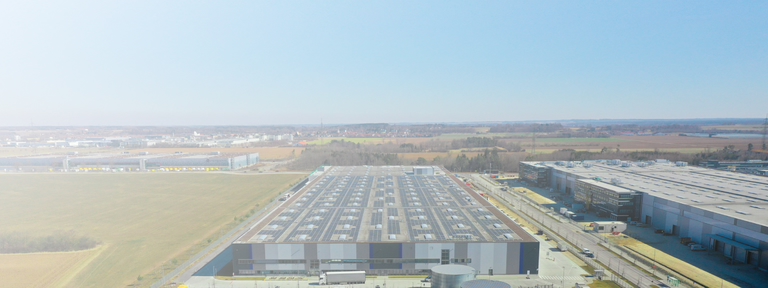
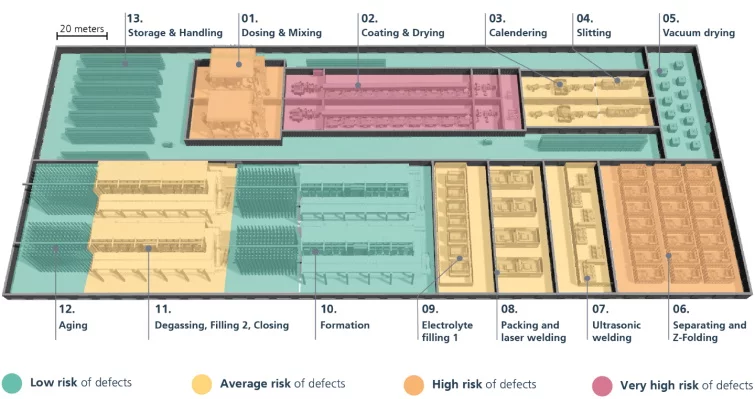
Gigafactories produce millions of battery cells—under conditions that permit less humidity than the Sahara. The dry room is not merely a structural box-ticking exercise in this context. It determines yield, scrap rate, energy balance, and ultimately the cost-effectiveness of the entire production operation.
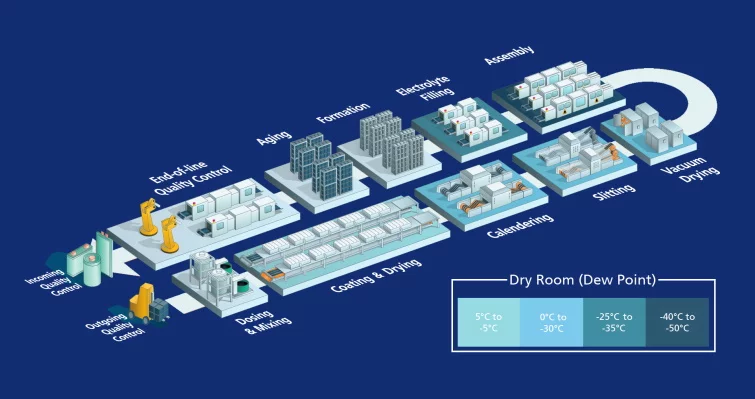
In lithium-ion battery production, moisture is the invisible enemy. Even small amounts of water in the air react with lithium-containing electrode and electrolyte materials—with direct consequences for the cell's capacity, service life, and safety. A Dry Room is a hermetically sealed production environment with a controlled, extremely low dew point. In battery cell production, a dew point of −40 °C is typically targeted. For advanced chemistries—such as nickel-rich NMC cathodes or solid-state batteries—dew points down to −70 °C or −80 °C are required.
Critical manufacturing steps in the dry room:
| Feature | Research lab | Pilot Line | Gigafactory |
|---|---|---|---|
| Typical area | < 1,000 m² | 1,000–5,000 m² | > 10,000 m² (up to 48,000 m²) |
| Dehumidification units (DHUs) | 1–3 | 3–10 | 100+ |
| Airflow rate per unit | 2,000–5,000 m³/h | 5,000–20,000 m³/h | Up to 50,000 m³/h |
| Dew point requirement | –40 °C to –80 °C | –40 °C to –70 °C | −40 °C to −80 °C (process-dependent) |
| Number of people in the room | Few | Limited | Minimized through robotics |
| Flexibility | Very high (modular, reconfigurable) | Medium | Low (fixed infrastructure) |
| Primary moisture-load driver | Lab equipment | Equipment + operators | Process volume + residual personnel |
| Clean room class | ISO 5-9 | ISO 6+ | ISO 7/8 combined (clean-dry room) |
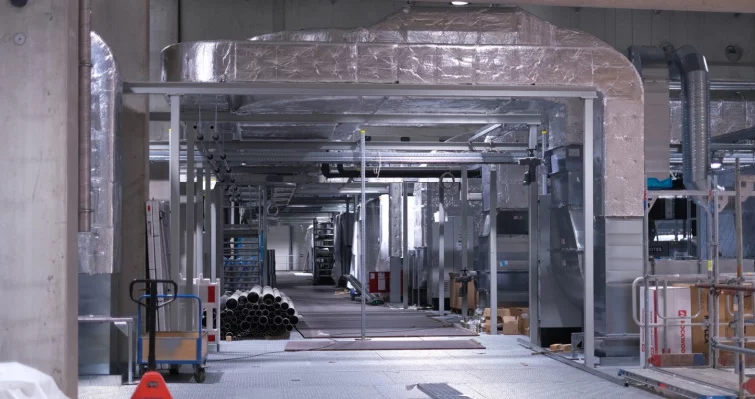
In the research lab, a dry room can be reconfigured within days—a new process variant, a changed humidity requirement, a different cell format.
In the pilot line, flexibility already becomes more expensive: Every change to the HVAC concept, material flow, or airlock concept costs time and money—but is still manageable.
In the gigafactory, flexibility is a strategic cost factor. A hermetically sealed production hall with 100+ dehumidification units, certified air distribution systems, and fully automated lines is designed for stability, not for change. Changes to the room concept, new cell technologies with differing humidity requirements, or process conversions can mean weeks of downtime and costs in the millions.
The consequence for planning: Anyone building a giga-fab must plan for flexibility before the first ground is broken—through modular zone concepts, standardized interfaces, and scalable HVAC systems.
Inadequately controlled dry rooms generate direct scrap costs as well as hidden costs through rework, longer formation processes, and greater inspection efforts.
In battery production, yield – the proportion of defect-free cells – is the decisive economic lever. Inadequately controlled dry rooms generate direct scrap costs as well as hidden costs through rework, longer formation processes, and greater inspection efforts.
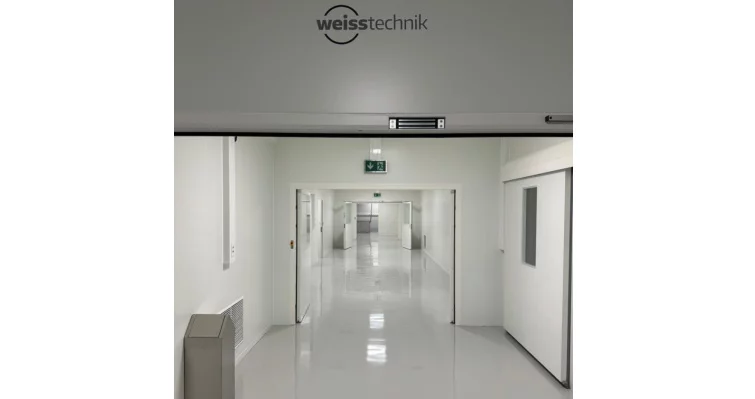
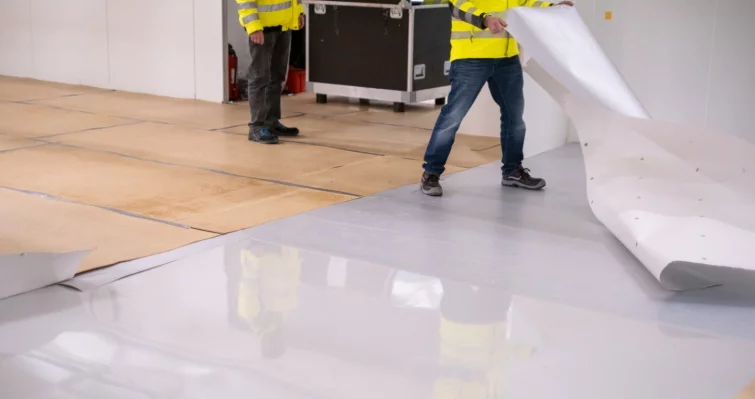
The most efficient means of defect prevention in the dry room is architectural in nature:
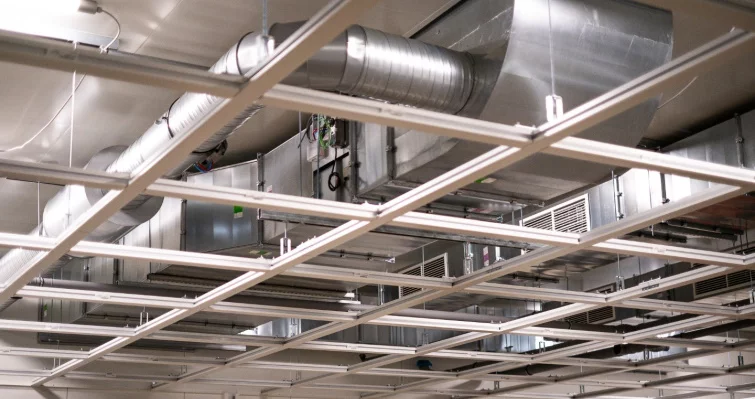
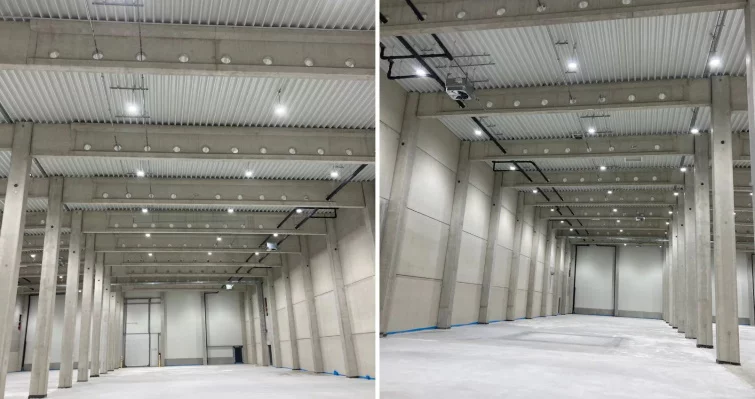
The most common planning error in the transition from the pilot line to the gigafactory: People think in multipliers. "We have 4 dehumidification units for 5,000 m²—for 50,000 m² we need 40 units.” But scaling is not linear:
Operating a giga-fab dry room is energy-intensive. Studies and field data show: The dry room and its climate control consume over 40% of total factory power —more than any other single area of the facility. Figures from an FFB study (illustrative, for an airflow rate of 500,000 m³/h at a −40 °C dew point):
| System | Annual consumption (GWh) |
|---|---|
| Conventional single-stage system, 100% fresh air | 48.8 |
| Conventional single-stage system, 25 % fresh air | 26.6 |
| Optimized system with waste heat / heat pump | 6.1–18.7 |
Savings potential: Up to 80% of dehumidification energy consumption can be saved through optimized system architectures—via recirculated air, waste heat utilization, heat pump integration, and multi-stage adsorption systems. For a single system with 500,000 m³/h air capacity, this corresponds to potentially 40 GWh/year.