Li-ion cell
Different cell chemistry, rising power density -- dry room dew points −30 °C to −60 °C
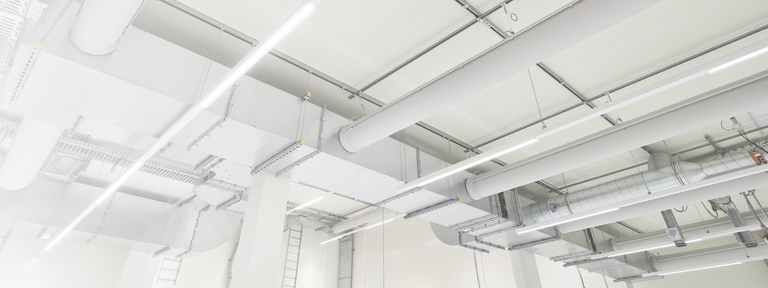
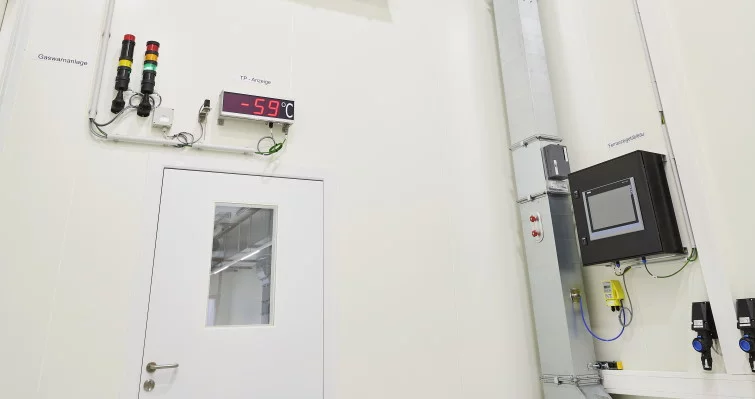
Dry rooms for supercapacitors, thermal batteries, and fuze batteries—planned and built to the specific requirements of your production
Lithium-ion batteries have made dry room technology well known. Gigafactories worldwide are investing hundreds of millions of euros in production environments with dew points of –40 °C to –70 °C to protect their sensitive electrodes and electrolytes.
But the growing market for specialty and high-performance batteries places different—often stricter, yet in some respects also fundamentally different—demands on the production environment. Supercapacitors, thermal batteries, and military reserve and fuze batteries follow their own rules.
Those who understand these differences and derive the right room planning from them minimize scrap, ensure quality, and meet industry-specific standards—from ISO 14644 to the military standard VG 96915.
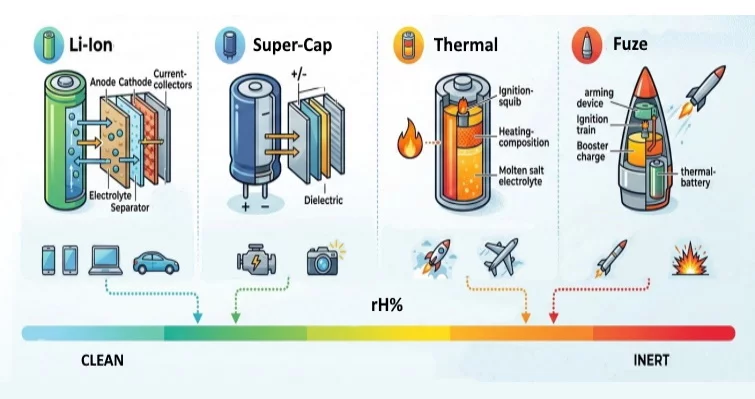
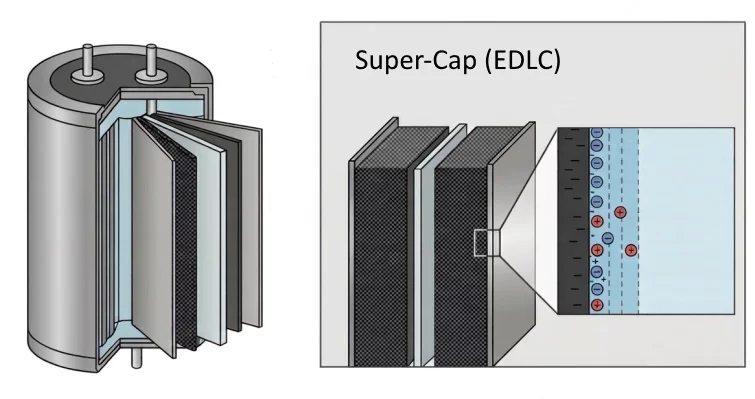
Electrochemical double layer capacitors (EDLCs) are among the most dynamic growth markets in the energy storage industry. They stand out with extremely high power density, short charge/discharge times, and millions of cycles – ideal for high-current applications, energy recovery, and buffer systems.
Electrochemical Principle and Moisture Risk:
Commercial EDLCs for high-voltage applications (> 2.5 V) use organic electrolytes – typically TEABF dissolved in acetonitrile or propylene carbonate. These electrolytes are highly moisture-sensitive.
Penetrating moisture produces hydrogen fluoride (HF). The result is the same as with Li-ion batteries: electrode corrosion, increased internal resistance, reduced capacity, and shortened service life.
| Feature | EDLC Production | Li-Ion Production |
|---|---|---|
| Dew point requirement | ≤ –40 °C (recommended) | –40 °C to –70 °C |
| Primary Hazard | HF from BF₄⁻ hydrolysis | HF from LiPF₆ hydrolysis |
| Reactive Lithium Metal | No | Yes |
| ESD Protection (electrostatic) | Critical (activated carbon) | Less critical |
| Particle Cleanliness | High (ISO 7–8) | Medium to high |
| Fire Class | Solvent (acetonitrile) | Lithium + solvent |
| Room Size (typical) | Small to medium | Medium to gigafactory |
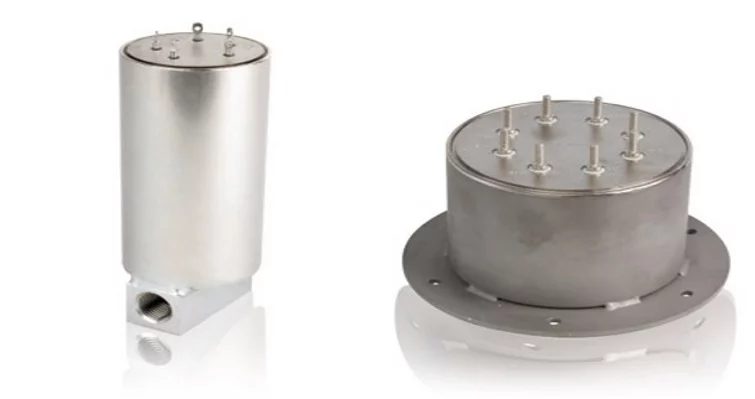
Thermal batteries (also known as: activatable reserve batteries) appear unremarkable at first glance – stored for decades in a completely inactive state, activated within a fraction of a second by pyrotechnic heat sources. They deliver high currents within milliseconds under extreme conditions: shock, vibration, temperatures up to +150 °C. No solvent, no polymer-based separator – only solid-state systems.
Their fields of application: guided munitions, artillery fuzes, cruise missiles, rocket propulsion, defense technology worldwide.
The Electrochemical System:
Standard thermal batteries today are based on the Li-Si/FeS₂ system with a molten salt electrolyte made of LiCl-KCl eutectic and MgO as a binder. All components are present as pressed powder pellets – and this is precisely what determines the manufacturing environment:
| Aspect | Thermal Battery | Li-Ion Battery |
|---|---|---|
| Primary Environmental Requirement | Inert gas atmosphere (Ar/N₂) | Dry air (dew point –40 to –70 °C) |
| Moisture Control | Critical (LiCl-KCl hygroscopic) | Critical |
| Oxygen Exclusion | Critical (Li-Si anode, FeS₂) | Less critical |
| Process Vessels | Glove boxes | Large-scale dry rooms |
| Production Scale | Small batch, unit production | Mass production |
| Shelf Life | Up to 25 years storage | 3–15 years |
| Defense Standards | MIL-SPEC, STANAG | Automotive, IEC |
| Pyrotechnic Components | Yes (heat pellets: Fe/KClO₄) | No |
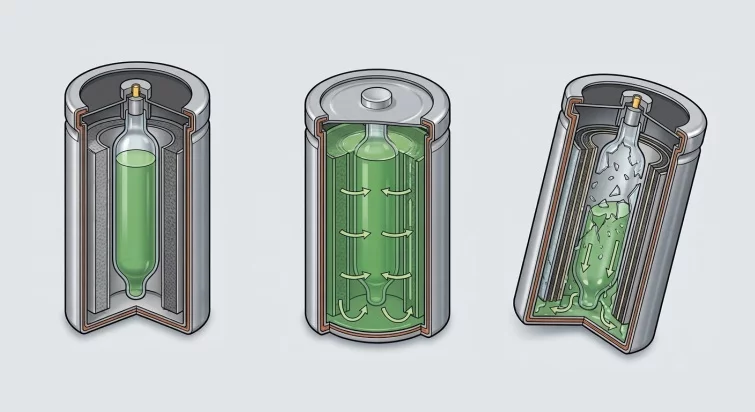
In the defense context, fuze batteries refers to activatable primary batteries used in ignition systems for artillery ammunition, torpedoes, guided missiles, and other weapons systems. They must function reliably – after 20 years of storage, under shock loads of > 20,000 g, and at temperatures from –50 °C to +70 °C.
The products are based on activatable lithium-thionyl chloride reserve batteries (Li/SOCl₂) and meet military standards such as VG 96915-303.
- Dew point zoning concept (multi-stage dry rooms, airlocks, transition zones)
- Inert gas concepts (argon/nitrogen) with O₂ monitoring
- ATEX zone classification and equipment specification
- Energy efficiency analysis (life cycle costs, waste heat utilization)
- Cleanroom classification per ISO 14644-1/-2
- Adsorption dryers with silica gel rotor: dew points down to –70 °C achievable
- Mini-environments / dry glove boxes: for small production volumes and inert gas requirements
- HEPA/ULPA filter systems: particle reduction ISO 5–8
- ESD flooring and fixtures: discharge resistance per EN 61340
- Pressure control systems: positive-pressure cascades with fast pressure tracking
- Real-time monitoring: dew point sensors, O₂ analyzers, particle counters, SCADA integration
- ATEX-compliant electrical installation (Zone 1/2 and Zone 21/22)
- Pressure relief and escape route concepts
- Access and logging systems per defense industry standards
- Support through regulatory approval processes (emissions control, explosives authorities)
- Commissioning and qualification
- Maintenance contracts and remote monitoring
- Training for your operating personnel
- Energy audits and optimization recommendations
| Requirement | Li-Ion | EDLC | Thermal Battery | Fuze Battery |
|---|---|---|---|---|
| Dew point ≤ –40 °C | ✅ | ✅ | ✅ (pre-zones) | ✅ |
| Dew point ≤ –70 °C | (in some cases) | ❌ | ❌ | ❌ |
| Inert gas atmosphere | ❌ (partial only) | ❌ | ✅ | ❌ (typically) |
| ATEX zones | ❌ | ✅ (acetonitrile) | (special case) | ✅ |
| ESD protection | Medium | High | Medium | High |
| Clean room class | ISO 7-8 | ISO 7-8 | Project-dependent | ISO 8 |
| Military standards | ❌ | ❌ | ✅ | ✅ |
| Explosives Act | ❌ | ❌ | ✅ | ✅ |
| Production size | Large–gigafactory | Small–medium | Small (unit) | Small–medium |
we know the regulatory frameworks
| Standard / Regulation | Contents | Application |
|---|---|---|
| ISO 14644-1/-2 | Cleanroom classification and monitoring | EDLC, fuze battery, thermal battery |
| ATEX Directive 2014/34/EU | Explosion protection for equipment and protective systems | EDLC (acetonitrile), fuze battery |
| EN 61340-5-1 | ESD protection in electronic environments | EDLC Production |
| MIL-STD-810H | Environmental testing for military equipment | Fuze battery, thermal battery |
| AQAP 2110/2310 | NATO quality management system | Military defense goods |
| VG 96915 | German defense equipment standard for batteries | Fuze batteries (e.g., Diehl) |
| SprengG (Germany) | Explosives Act, including 2nd SprengV | Thermal battery, fuze battery |
| IEC 62133 / UN 38.3 | Safety of primary batteries | Transport, storage |